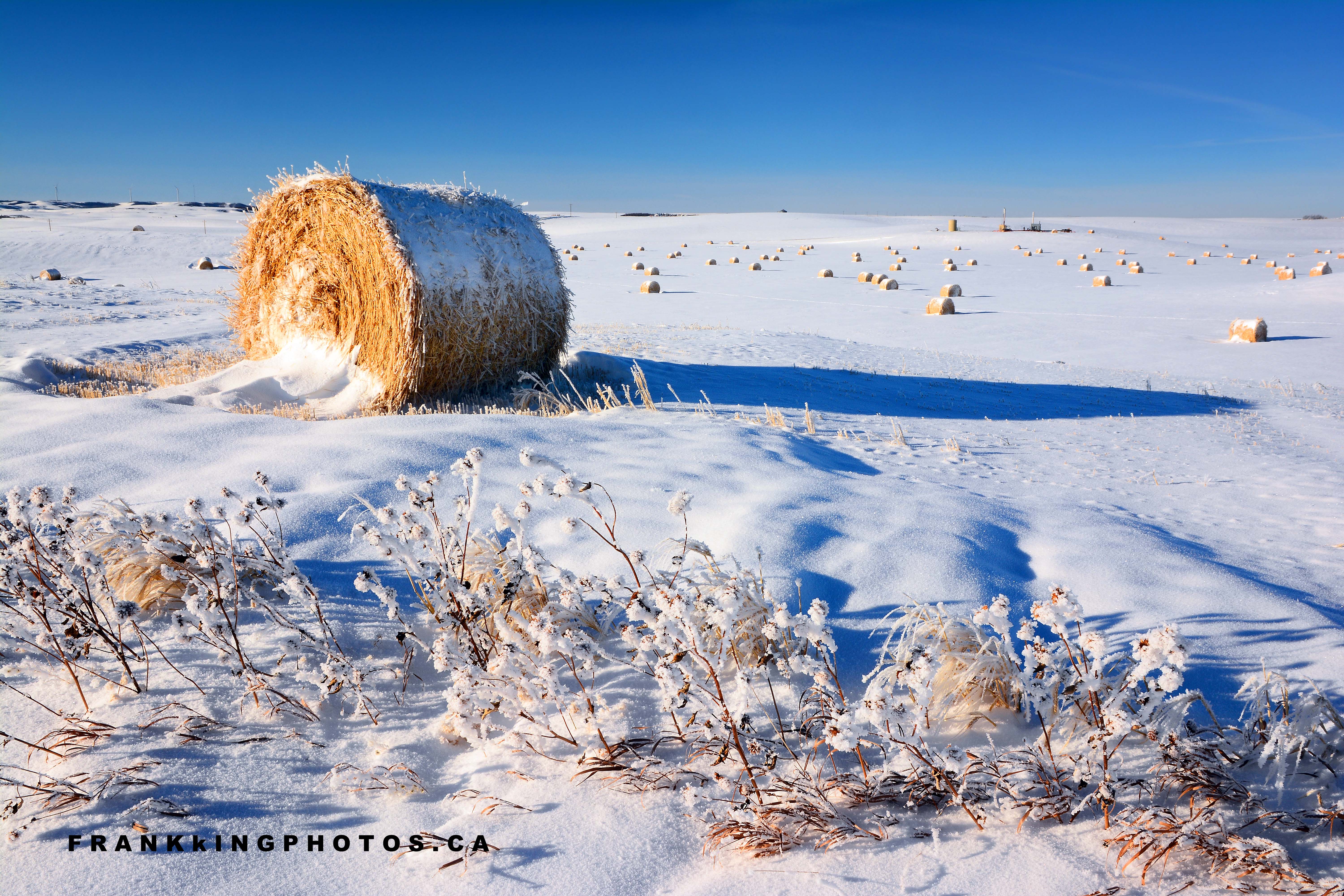
Regular visitors to this website will know I’m a sucker for hayrolls. Those perfectly cyclindrical shapes, scattered over fields, makes for mighty compelling compositions. Add on new snow and frost and you have scenes like this. What a blessing it is to live in a land where this type of photography is possible. 🙂 Nikon D7100, tripod, polarizing filter
Click on the picture for a larger view.
Want to buy this picture? Email me and I’ll make it happen! (fdking@hotmail.com).
Check out my coffeetable book, “Frank King’s Southern Alberta“: http://bit.ly/1oUzd4A
Hay in my area (Imperial Valley, California) is stacked in large, rectangular bales. The local Navy base is surrounded by hay farms and onlookers climb atop the 12-foot stacks to watch the Blue Angels practice. On take-offs and landings, the pilots can see the “hay-balers” beneath them.
Due to liability issues, farmers have relocated the hay bales, but spectators have resorted to standing atop their vehicles.
[I included an amazing video of this but the comment didn’t post. Some blogs don’t allow inserted links in the comments.]
Environmentalists have sought to curb the production of hay — which is sold to the local cattle ranchers — because the crop requires a whole lot of water … and then there is the issue of cows emitting methane gas. Naysayers would prefer that hay farmers and cattlemen would simply go away.
In full disclosure, our family farm — which is now owned by a conglomerate — has always been a hay farm.
 FRANK KING PHOTOS
Beautiful!
Hay in my area (Imperial Valley, California) is stacked in large, rectangular bales. The local Navy base is surrounded by hay farms and onlookers climb atop the 12-foot stacks to watch the Blue Angels practice. On take-offs and landings, the pilots can see the “hay-balers” beneath them.
Due to liability issues, farmers have relocated the hay bales, but spectators have resorted to standing atop their vehicles.
[I included an amazing video of this but the comment didn’t post. Some blogs don’t allow inserted links in the comments.]
Environmentalists have sought to curb the production of hay — which is sold to the local cattle ranchers — because the crop requires a whole lot of water … and then there is the issue of cows emitting methane gas. Naysayers would prefer that hay farmers and cattlemen would simply go away.
In full disclosure, our family farm — which is now owned by a conglomerate — has always been a hay farm.